
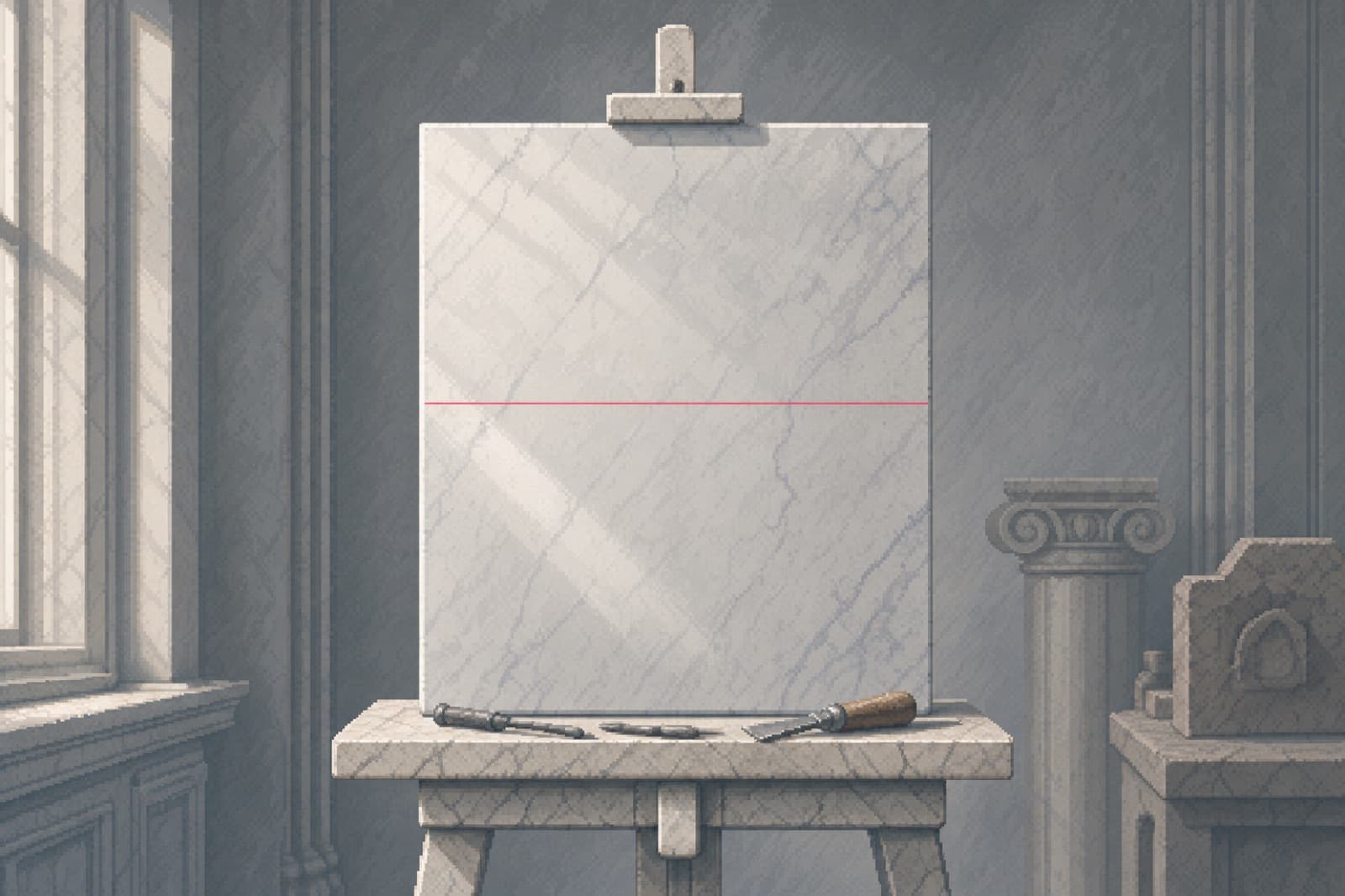
The empty editor: why starting from done beats a blank page
 Viktor Kacenak
The cursor blinks in an empty title field. Module one, lesson one, body blank. You know this subject cold, you have taught it across a hundred calls, and still the screen just sits there waiting for you to make the first move.
Twenty minutes later you have renamed the course twice and changed nothing else.
That screen is the villain. Not your discipline, not your topic, not your audience. The empty editor is where expert courses go to die, and it wins because the work starts at zero, and zero is the most expensive place to begin.
You beat it the same way every time. Stop starting from nothing. You open a finished, professionally built course on your topic and you make it yours, rewriting in your voice instead of writing from a blank page. Creating becomes editing, and editing is something you already do in your sleep.
Why does a blank editor beat an expert who knows the subject cold?
Because knowing the subject and building the course are two different jobs, and the editor only helps with the second one.
You can talk about your method for an hour without notes. But "module one, lesson one, empty body, blinking cursor" is a different task from knowing your method. It asks you to be a curriculum designer, a scriptwriter, and a producer at the same moment, and it hands you a blank sheet to do it on. Your brain reads that open, shapeless task as a threat and quietly routes around it.
So you reorder the outline. You pick a nicer font. You go read a competitor's sales page to feel productive. Then you close the tab.
The expertise was never the bottleneck. The blank page was. A person who could teach this live all day still freezes the second the work starts from nothing, because nothing is the hardest thing to react to.
What is the empty editor really costing you?
That blank page does not just feel expensive. It is, and the number is bigger than you would guess.
The Chapman Alliance's widely cited study on e-learning development pegged the cost of one finished hour of course material at 49 to 716 hours of work, depending on how interactive it is. A plain slides-and-voice lesson sits near the floor. Anything with real structure, assessments, and polish climbs fast toward the top.
What a blank page actually asks of you
Run that on a modest four-hour course and the empty editor is quietly asking you for a part-time job that lasts months, all of it before a single student pays you a cent.
And that figure only counts the writing and production. It does not count the outline you scrap and rebuild, the recording you redo because the first take rambled, or the afternoons you lose deciding how a course should even be shaped. The blank page taxes you before you ever produce a single finished minute.
That is the real size of the task hiding behind the blinking cursor. No wonder the tab stops getting opened. The cost lands up front, the reward stays uncertain and far away, and that shape makes the project easy to pause and brutal to restart. We laid out the full anatomy of that stall in why most online courses never get finished.
Why doesn't "just start" ever work?
Because "just start" points you straight back at the thing that beat you.
The advice assumes the problem is inertia, a body at rest. It is not. You are not resting, you are avoiding a specific task that your brain has correctly flagged as costly. Telling a blocked expert to "just open the editor and type" is telling them to walk back into the exact room where they froze last time.
This is why the productive-guilt loop never ends. You add "finish the course" to Monday, you flinch off it by Tuesday, and you carry the same undone task forward for months, reading your own procrastination as proof you are not cut out for this. But you are cut out for it. You are just walking into the wrong room.
Willpower is not the missing piece. Structure is.
Give someone a blank document and a deadline and most people stall. Give the same person a rough draft and ask them to fix it, and they turn sharp and fast, because now there is something in front of them to react to. Reacting is easier than creating, every single time. An expert with a draft to react to is unstoppable. An expert with a blank page is a person renaming a course at midnight.
So the honest move is to refuse to start from zero at all.
What does starting from done actually change?
It turns the job of writing into the job of editing, and that swap is the whole game.
Two ways to begin
Empty editor
You create from zero
Starts done
You edit from a finished draft
When a course arrives already structured, the frightening 80 percent is already on the page: the module order, the lesson breakdown, the arc that carries a beginner to an outcome. Your task collapses to the 20 percent only you can do. Rewrite a lesson in your own words. Swap a generic example for the one from your own work. Cut the two modules that do not fit your audience. Add the hard-won bit no template could know.
None of that is a blank page. All of it is editing.
This is the difference between staring at a cursor and shipping by the weekend. You are not less capable at a blank page. You are just aimed at the wrong task. Point the same expertise at a finished draft and the work you were dreading turns into an afternoon of good judgment calls. It is the same principle behind a self-running academy: the starting line is a stocked library, not an empty room.
Start from a finished course, not a blank page
See itHow do you make a finished course unmistakably yours?
This is the fear that keeps people at the blank page anyway: if I do not build it from scratch, it will not really be mine, and my audience will smell the template.
Fair worry. A stocked shelf that looks like everyone else's shelf is worth nothing. So ownership is not an afterthought here, it is the point of the second step.
You take a professionally built lesson and rewrite it in your voice from one plain instruction. Drop in your industry's examples. You add the lessons only you can teach, the ones that come from your actual clients and your actual failures. The whole thing goes on your own domain, under your own brand, so a student never sees a platform logo. The content stops being generic the moment you touch it, and you decide how much to touch. See how to create a course when you already know the subject for the mechanics.
Here is the reframe that matters. Starting from done does not make the course less yours.
It moves your effort off production and onto the part that carries your name. You spend your hours on voice, judgment, and the examples nobody else has, instead of on formatting slides and fighting a blank body field. The result is more yours than a from-scratch course, not less, because your fingerprints land where students actually feel them.
Why does this decide whether the course ever ships at all?
Because a course that dies in the editor helps no one, no matter how good it would have been.
The common line is that most courses are never finished. Treat the exact percentage carefully, since clean industry figures are hard to pin down, but the direction is not in dispute: far more courses get started than get shipped, and the empty editor is where most of them stall out. That makes your unfinished course the default outcome of starting from zero, not the personal failure it feels like.
And there is a second failure waiting past the finish line. Research on self-paced courses has for years reported completion below 15 percent, while structured, supported programs reach as high as 70 percent. The blank page stalls the builder, and a course with no built-in momentum then loses the students who paid. Both problems trace back to the same root: too much undifferentiated work, started from nothing, with no structure holding it together.
Start from done and you pull that root out on both ends. The build gets a spine, so it ships. The students get a spine, so they finish. If you are still deciding whether to package what you know at all, your expertise is an asset worth more than the hours you rent it out in.
You do not have a discipline problem, and your idea was never the issue. You have a blank-page problem, and the blank page is optional.
Close the empty editor. Start from something finished, and make it yours.
Frequently asked questions
- Why is starting a course so hard?
- Because knowing your subject and building a course are two different tasks, and only the first one is easy for you. You can teach the material in your sleep, but an empty editor asks you to be a curriculum designer, a producer, and a project manager all at once, starting from a blank title field. The work begins at zero, and zero carries no momentum, no structure, and no first draft to react to. That gap between what you know and what the screen demands is where most courses stall in week three.
- What is the blank page problem?
- The blank page problem is the paralysis that hits when you face an empty document, editor, or canvas with no starting structure. Your brain treats the open, undefined task as a threat, so you avoid it: you reorder the outline, tweak the logo, research a competitor, and close the tab. It is not a lack of knowledge or discipline. It is that a blank page gives you nothing to edit, and editing is far easier than creating. For course builders, the empty editor is the single most common place a project dies.
- Is it better to build a course from scratch or from a template?
- For most experts, starting from an existing, professionally built structure beats starting from scratch. From-scratch means you carry the full production load, commonly estimated at 49 to 716 hours of work per finished hour of material, before anyone pays you. Starting from a finished course flips the job from creating to editing: you rewrite lessons in your voice, swap in your examples, and cut what does not fit. You keep full ownership of the result while skipping the blank-page stall. Building from zero only makes sense when no structured starting point exists for your topic.
- How do you get past the blank page when creating a course?
- Stop trying to start it. Shrink the blank part instead. Begin from an existing structured course on your topic and react to it, rather than generating from nothing: cut a module, rewrite a lesson in your words, add the one example only you can give. Reacting is faster than creating because you always have something in front of you to fix. Narrow the scope to one clear outcome so the task stays finishable, and separate the writing from the operational jobs (hosting, pricing, support) so they do not pile onto the same blocked afternoon.
Keep reading

Cohort vs self-paced courses: which one actually finishes?
Cohort vs self-paced: a cohort-based course finishes far better, as high as 70 percent, because deadlines and a group pull people to the end, but it runs on your live calendar. Self-paced scales to anyone but drifts below 15 percent. Here is the honest comparison and the third option.
 Tomas Placko
Online course completion rates: the real numbers (2026)
The online course completion rate for self-paced courses is commonly reported below 15 percent, often cited near 13 percent, while structured and cohort-based courses reach as high as 70 percent. Here are the real numbers, the named sources, and what moves them.
 Jaro Suranyi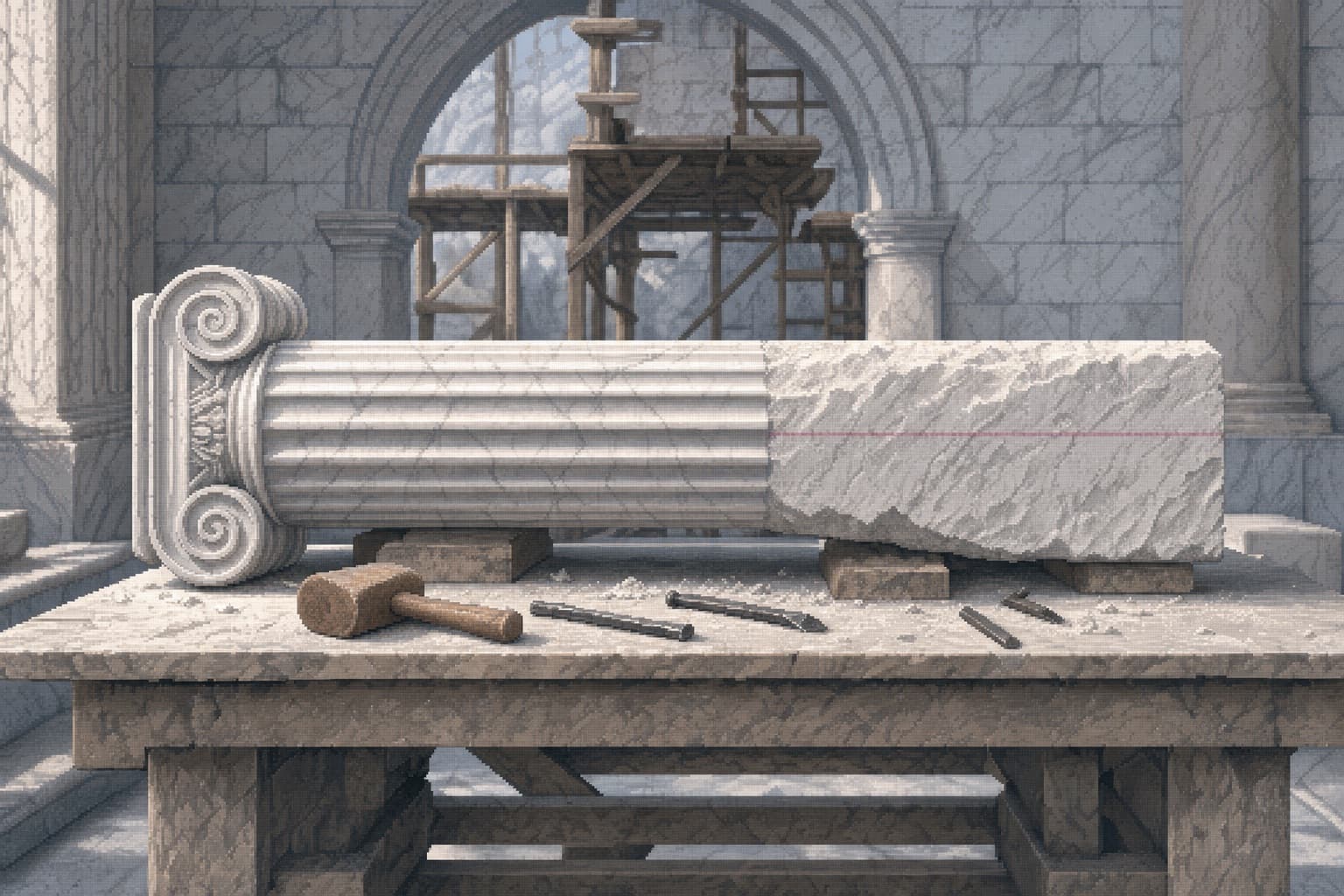
Why most online courses never get finished
The real reason why online courses fail is rarely the idea or the market. Most die in the editor, stalled by production cost, blank-page paralysis, and the fact that creating the lessons is only the first of six jobs. Here is the anatomy of the stall, with the numbers.
 Viktor Kacenak
The thinking behind the future of online academies.
The ideas, the numbers, and what owners are launching with it. One email a month. No noise.